Insects are ubiquitous. They inhabit nearly every habitat on the planet including freshwater lakes and streams. Having clean freshwater is not only important for human consumption but for the general health of aquatic ecosystems. Many insect species can be indicators of clean water as their larvae develop over extended time periods in freshwater. Of these species, insects in the orders Plecoptera, Ephemeroptera, and Trichoptera are often associated with clean, fast moving waters. By contrast, many Dipteran species such as midges and mosquitoes can thrive in sub-optimal conditions with little oxygen or significant organic nutrient waste.
For more information regarding insects used in water quality testing visit: EPA: Macroinvertebrates.
Monday, October 27, 2014
Tuesday, October 21, 2014
Insects as food
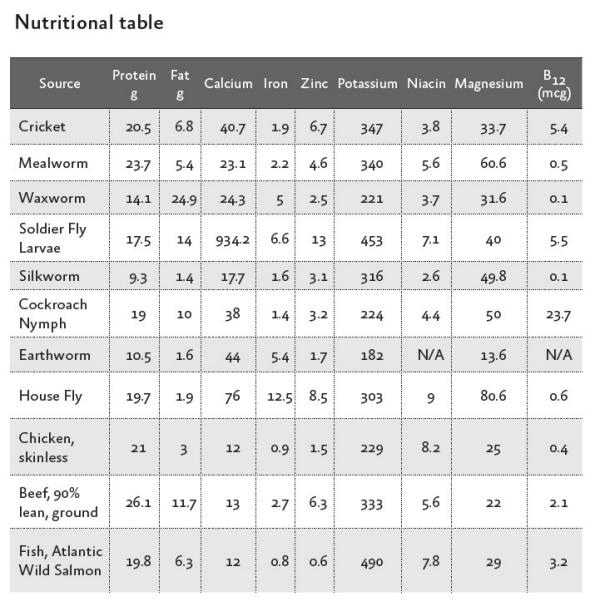
While it may seem repulsive to some, the consumption of insects or entomophagy is a common practice in many countries around the world. Insects when compared to other sources of meat require less natural resources and have pound for pound more protein than other more common meat sources (Holland, 2014). Live Science author, Marc Lallanilla (2013), highlights 7 insects that we will more than likely be eating in the near future. Of these insects listed here, meal worms are probably the most widespread and type of insects a budding entomophagist would consume. I personally have no objections to consuming insects for food and have tried a number of different dried samples of meal worms, wax worms, and crickets. The wax worms were particularly tasty and reminded me of a cheese curl. I provided a table showing the protein, fat, and other nutrients in various organisms from Slate.com. You can check out the article here.
So would you eat insects? I know I would if I could readily purchase them at the store like a steak or hamburger patty. Let the food revolution begin!
Works Cited:
Holland, J. (2013, May 14). U.N. Urges Eating Insects; 8 Popular Bugs to Try. Retrieved October 21, 2014.
Lallanilla, M. (2013, October 1). 7 Insects You'll Be Eating in the Future. Retrieved October 21, 2014.
Martin, D. (2014, April 28). Stop Adding Protein Powder to Your Post-Workout Shake. Add Bugs Instead. Retrieved October 21, 2014.
Monday, October 13, 2014
Insect Respiration
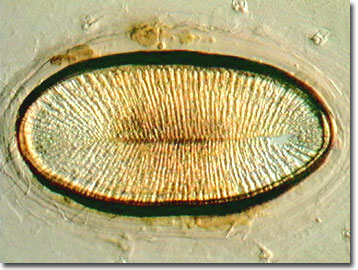
Insects respire through opening in the sides of the abdomen or thorax known as spiracles. Spiracles regulate the flow of oxygen and carbon dioxide gases within the insect tissues. Unlike humans which use blood to transport gases both to and from the tissues, insects do not use their blood (hemolymph) for this purpose. Instead oxygen gas passes directly into the tissues through a series of hollow tubes called tracheoles.
Microscopy of Insect Spiracle (Kelly, Fellers, & Davidson, 2003)
Insects that are aquatic have a number of other modifications for accessing oxygen from water. In some cases external gills, such as those seen on a mayfly larva, are used to gather oxygen from running water. Air bubbles, thoracic pumping, and breathing tubes are also employed by insects that live aquatic or semi-aquatic lives. For more information about insect respiration visit this link: Insect Respiration
Works Cited:
Kelly, C.D., Fellers, T.J., & Davidson, M.W. (2003)Molecular Expressions: Science, Optics & You - Olympus MIC-D: Oblique Gallery - Insect Spiracles. (n.d.). Retrieved October 13, 2014.
Tuesday, October 7, 2014
Insect Development: Complete Metamorphosis
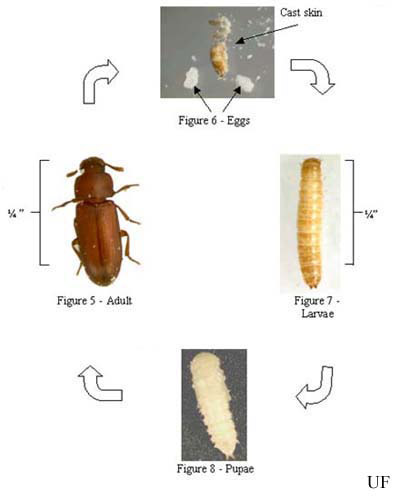
Insects exhibit a diverse array of developmental strategies. The development most commonly associated with insects is the life cycle of a butterflies in which an egg hatches into a caterpillar, the caterpillar creates a cocoon or chrysalis, and then the adult butterfly emerges. This type of development exhibited by butterflies is termed holometabolous development. Many insects exhibit holometabolous development such as beetles (Coleoptera), flies (Diptera), Dobsonflies (Megaloptera), and a number of other insect orders. Insects that have complete or holometabolous development look vastly different when comparing larval forms and adults. Also all holometabolous insects have a pupation period where physiological changes occur in the last instar that lead to adult characters.
Confused Flour Beetle Life Cycle (Baldwin & Fasulo, 2014)
Control of when to pupate or molt is largely controlled by the hormones ecdysone and juvenile hormone. As the name implies, juvenile hormone promotes larval characteristics and inhibits molting or pupation. By contrast ecdysone promotes molting, pupation, and the development of adult characteristics (Meyer, 2006). For a more thorough introduction to molting and the hormones associated with it visit this link.
Works Cited:
Baldwin, R. & Fasulo, T.R. (2014) "Featured Creature: Confused Flour Beetle". http://entnemdept.ufl.edu/creatures/urban/beetles/red_flour_beetle.htm
Meyer, J.R. (2005). "The Endocrine System: Hormonal Control of Molting & Metamorphosis" North Carolina State. http://www.cals.ncsu.edu/course/ent425/tutorial/endocrine2.html
Monday, September 29, 2014
Insect Vision
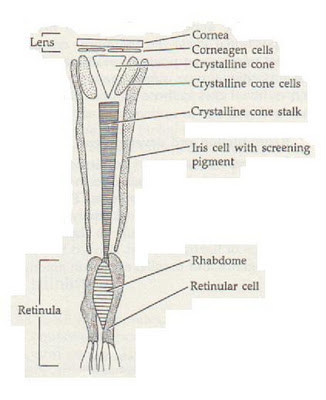
Insect vision unlike human vision uses multifaceted lens in a structure referred to as compound eyes. These compound eyes are composed of smaller units called ommatidia. Each ommatidium is composed a retinal cell, a crystalline cone, up to eight rhabdomeres and a sensory neuron. Light collected by the ommatidia are then used to generate a mosaic image in the insect brain. Many insects also have smaller light sensing structures called ocelli. Ocelli are often found in larval forms of holometabolous insects and are primitive eyes used primarily for sensing changes in light as they lack .
Many insects can see color as well as perceive wavelengths of light imperceptible to the human eye. For example, honey bees (A. mellifera ) can detect ultraviolet light. The additional wavelengths often can provide "nectar trails" that are invisible to the human eye (Stanley, 2014). A comparison of floral colors between humans and honey bees can be found here. Also, if you've ever wanted to experience vision through the eyes of a bee (because who hasn't, right?) visit this site.
Works Cited:
Stanley, C. 2012. Honey bee navigation. Utah PESTS News Vol. IV, Winter 2012.
Wednesday, September 17, 2014
Why are Puppies so darn cute?
Baby animals are adorable including those of the human variety. If you don't believe me just take a look on YouTube at the huge number of videos of babies doing cute things like laughing or puppies rolling on the ground. Why do we find these simple acts so "precious" in babies but not in adults? Believe it or not there is an evolutionary link between cuteness and human babies. Famous evolutionary biologist, Stephen Jay Gould wrote a rather popular essay detailing the evolution of the Disney character, Mickey Mouse, from a pointy nosed rat to the the lovable round headed mouse most of us associated with the character. The essay, readily found online explains that many of the baby critters we find so precious have enlarged heads and eyes much like human babies, are relatively uncoordinated, and have large deposits of fat. If these characters sound familiar, they should as they could describe a human baby as well as an adorable panda cub. Humans are hardwired to care for children to further the species. It just so happens that being cute helps promote care of children until they no longer need parental care. This love of tubby little big headed critters spills over into our selection for pets and what we choose to eat or not eat. Go give your puppy a hug.
Works cited:
Stephen Jay Gould. "A Biological Homage to Mickey Mouse." Ecotone 4.1 (2008): 333-340.
Wednesday, September 3, 2014
If a Problem Comes Along You Must Google It!
The phrase, "Just Google It", is as common place as internet access through out the United States. The vast, tangled web, of information provided on the web as been both a blessing and a curse for those seeking knowledge on the internet. Recent research has found that information "googled" is less likely to be remembered than other traditional forms of learning (Krieger, 2011). Is this necessarily a bad thing? And our we as the human race becoming sequentially dumber as more and more information becomes available online? I suppose it depends on how someone views information previously stored in memory being allocated to the "cloud". Wegner & Ward (2013) through experimentation found that individuals rely on the internet to play the role of an "all knowing" friend. This "friend" can then help answer hard to remember facts or information that previously may have been committed to memory. Wegner & Ward (2013) also found that individuals allowed to use Google to find answers felt smarter than those who were not able to search answers from the internet. This false cognitive self esteem made individuals feel smarter despite the fact they knew less information and relied on Google as a memory source. Google is so pervasive I even have to capitalize it......
Works Cited:
Krieger,L.M. Google is changing your brain, study says, and don't you forget it. (n.d.). Retrieved September 3, 2014, retrieved from http://www.mercurynews.com/science/ci_18478827
Wegner, D., & Ward, D. (n.d.). The Internet Has Become the External Hard Drive for Our Memories. Retrieved September 3, 2014, retrieved from http://www.scientificamerican.com/article/the-internet-has-become-the-external-hard-drive-for-our-memories/?page=3
Works Cited:
Krieger,L.M. Google is changing your brain, study says, and don't you forget it. (n.d.). Retrieved September 3, 2014, retrieved from http://www.mercurynews.com/science/ci_18478827
Wegner, D., & Ward, D. (n.d.). The Internet Has Become the External Hard Drive for Our Memories. Retrieved September 3, 2014, retrieved from http://www.scientificamerican.com/article/the-internet-has-become-the-external-hard-drive-for-our-memories/?page=3
Subscribe to:
Posts (Atom)